Background
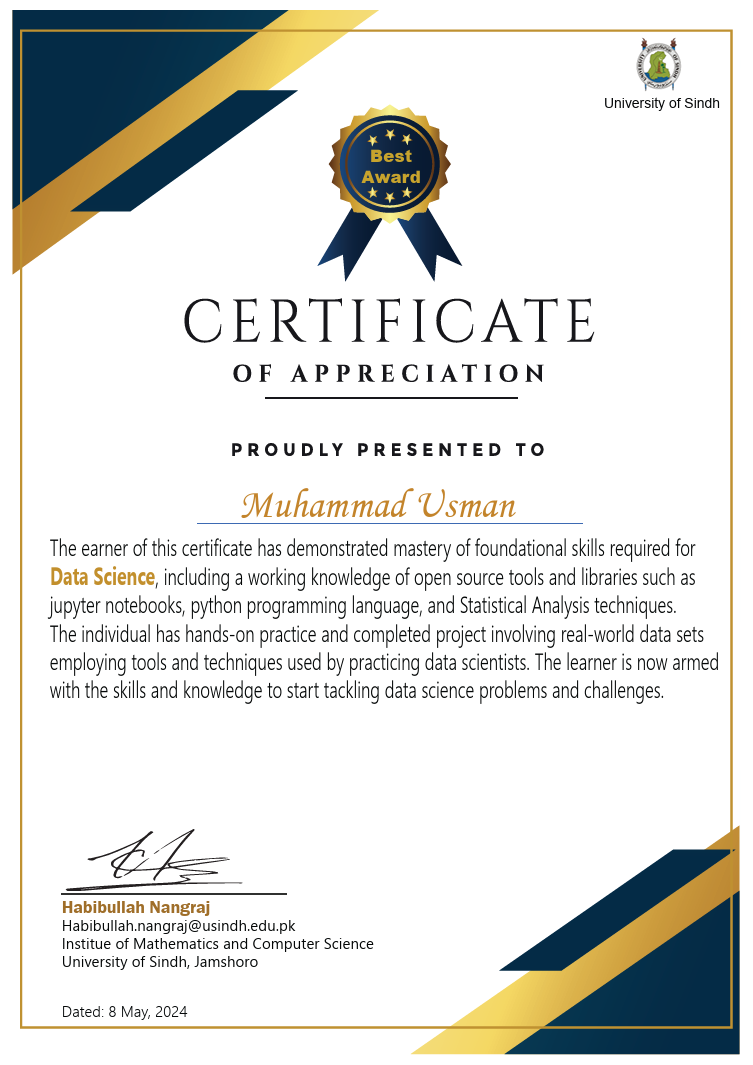
As part of a data science seminar project at the University of Sindh, our team investigated a question that sits at the intersection of education and technology: does increased technology use in the classroom actually improve student learning outcomes? The project was supervised by Habibullah Nangraj and was awarded best performance in the cohort.
Survey design
We designed a five-question Likert-scale survey targeting university students across three faculties:
- How frequently do you use digital tools (laptops, tablets, apps) during study sessions?
- Do you feel technology helps you understand course material better?
- Does online access to resources reduce your dependency on physical textbooks?
- Has technology improved your collaboration with classmates?
- Do you believe your grades have improved since adopting digital study tools?
We collected 312 valid responses after removing incomplete or duplicate entries.
Exploratory data analysis
Before testing any hypotheses, we profiled the data thoroughly.
Key distributions uncovered during EDA:
- 78 % of respondents reported using digital tools daily or almost daily.
- Self-reported grade improvement correlated positively with tool frequency (r = 0.61).
- Students who used collaboration tools (shared docs, group chats) scored 0.4 Likert points higher on perceived learning outcomes.
Seaborn heatmaps of inter-item correlations revealed that questions 1, 3, and 5 formed a tight cluster, suggesting a latent "digital engagement" factor driving overall satisfaction.
Hypothesis testing
We formulated two null hypotheses:
- H₀₁: There is no significant difference in perceived learning outcomes between high-frequency and low-frequency technology users.
- H₀₂: Technology use has no significant effect on collaborative learning behaviour.
Using an independent-samples t-test (α = 0.05) for H₀₁ and a chi-square test of independence for H₀₂, both null hypotheses were rejected:
| Test | Statistic | p-value | Decision | |---|---|---|---| | t-test (learning outcomes) | t = 4.82 | p < 0.001 | Reject H₀₁ | | Chi-square (collaboration) | χ² = 18.3 | p < 0.001 | Reject H₀₂ |
Findings
Technology integration has a statistically significant positive association with both perceived learning and collaborative behaviour. Notably, the effect was stronger among STEM students than humanities students, suggesting that domain-specific tooling (simulations, coding environments, data tools) amplifies the benefit.
Recommendations
- Universities should invest in domain-appropriate tooling rather than generic platforms.
- Instructors should design blended learning tasks that require digital collaboration, not just individual consumption.
- Students who lack device access showed significantly lower scores — equity of access remains the single biggest moderating variable.
Reflection
This project sharpened my skills in survey methodology, statistical testing with SciPy, and communicating quantitative findings to a non-technical audience. It was also a reminder that good research starts with a well-formed question, not a fancy model.
Certificate of Achievement
Awarded best performance in the cohort by supervisor Habibullah Nangraj.